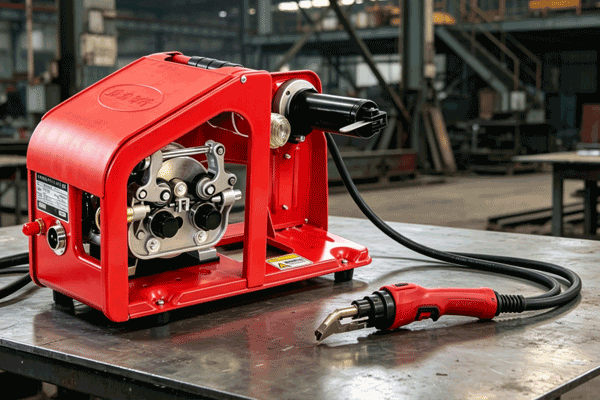

Can wire feeder work with aluminum welding wire?
TIME:2026-08-20 11:45:42 AUTHOR:Rende CLICK:81
Standard wire feeders can run aluminum welding wire, yet they cannot use the same configuration as carbon‑steel solid wire. Aluminum is soft and ductile. Without proper accessory upgrades, the wire will easily deform, crush, jam or scratch during feeding, resulting in unstable wire delivery and poor welding performance.
Several key parts must be replaced for aluminum wire application. First, V‑groove or U‑groove drive rolls are required instead of standard knurled grooves. Knurled drive rolls will bite and flatten soft aluminum wire. Second, a PTFE or teflon liner is essential. Steel liners create excessive friction and scratch aluminum surface, causing wire blockage inside the torch cable. The inlet guide tube also needs to be smooth to avoid scratching.
Operators should also adjust drive roll pressure to a lower setting. Too much pressure squeezes and deforms aluminum wire, while insufficient pressure leads to slipping and intermittent feeding. A longer straight section before entering the torch helps reduce wire twisting. Push‑pull wire feeders deliver the most reliable feeding effect for long‑cable aluminum welding jobs.
If these matching accessories and parameter settings are ignored, even a high‑quality wire feeder will face frequent wire jams, arc fluctuation and spatter problems. In short, common MIG wire feeders are compatible with aluminum wire after modification, but original carbon‑steel configuration is not suitable for direct aluminum welding.
More Information
-
Can wire feeder work with aluminum welding wire?
2026-08-20
-
What wire size can the wire feeder support?
2026-08-20
-
What consumables does a MIG welding torch use?
2026-08-20
-
What is the difference between air‑cooled and water‑cooled MIG welding torch?
2026-08-20
-
What’s the difference between air cooled and water cooled welding torch?
2026-07-08